~1 min
spotless
Micro Solutions / Life Science
Type strains in hours, not days: 30 isolates from culture to result in ~3 hours
Type strains in hours, not days: 30 isolates from culture to result in ~3 hours
Infrared spectroscopy for epidemiological surveillance and hospital hygiene
FT-IR system for rapid strain typing and support real-time epidemiological control.
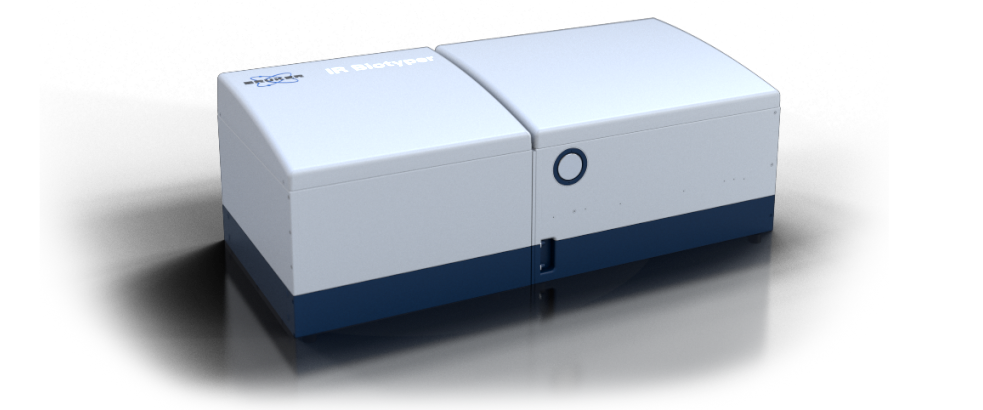
IR Biotyper captures the microorganism's infrared molecular fingerprint and classifies isolates by similarity. The solution helps identify clusters, track transmission pathways and conduct routine screening without lengthy molecular procedures.
Measuring a single spot takes about one minute; 30 samples can be obtained in less than three hours; using a reusable silicon wafer at 96 positions; analysis based on FT-IR spectroscopy, including a diagnostically significant region of 900-1,200 cm-1.
spotless
microplate-position
30 isolates
method
Analysis of 96-position silicon microplates
suspension - application - drying - measurement
| Method | Fourier Transformation Infrared Spectroscopy (FT-IR) |
|---|---|
| The main spectral region | 900–1200 cm−1 (polysaccharides); additional 1500–1800 cm−1 (proteins) and 2800–3000 cm−1 (fatty acids) |
| Time of measurement | ~1 min per spot; ~90 min per full microplate |
| Productivity of the workflow | up to 30 isolates (3 repetitions) for ~3 hours |
| Format | silicon microtiter microplate with 96 spots, reusable |
|---|---|
| Sample preparation | Suspension of pure culture in bottles of IR Biotyper Kit, application and drying |
| Analysis | PCA (2D/3D), dendrograms, distance matrices, IR Tracker |
|---|---|
| Classification | INS, SVM, random forest; built-in classifiers with regular updates |
| Data exchange | Imports from MALDI Biotyper, exports to LIMS (CSV) |
| Status | Not intended for clinical diagnosis |
A set of 5 reusable silicon microplates for 96 positions
Two bacterial IR test standards (IRTS 1 and IRTS 2) for 5 runs and vials for sample preparation of 50 isolates
Spectrum analysis, classification and visualization of clusters