360°
multi-view
Micro Solutions / Life Science
From living embryos to enlightened mouse brains: multi-track and lattice light-sheet shooting
From living embryos to enlightened mouse brains: multi-track and lattice light-sheet shooting
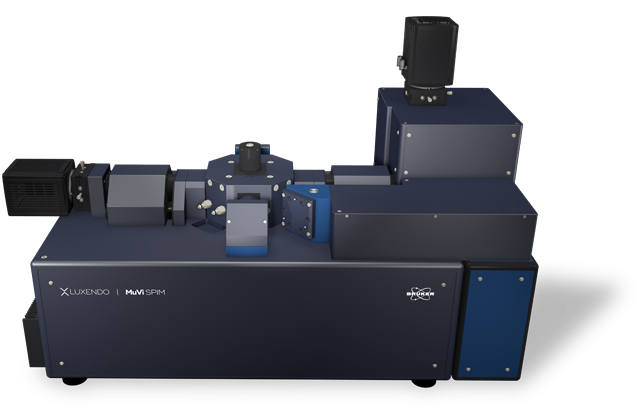
MuVi SPIM LS and CS for living and enlightened specimens, InVi SPIM Lattice Pro
Luxendo’s line of light-leaf microscopes covers tasks from multi-day imaging of living embryos to imaging the enlightened mouse brain and subcellular structures.
MuVi SPIM illuminates and registers a sample from two opposite sides, supports 360° rotation and is available in LS versions for living and CS for enlightened samples. InVi SPIM Lattice Pro in inverted geometry forms a gauss, Bessel or lattice light sheet using a light modulator and supports SIM, FLIM and FCS. The systems can be equipped with a photo manipulation module and are controlled by LuxControl software.
MuVi SPIM: up to six laser lines 405–785 nm, two-color detection, control 20–37 °C, CO2/O2/N2 and humidity (LS), the volume of the illuminated sample up to 15 × 15 × 20 mm (CS), lenses 4×–20 × InVi SPIM Lattice Pro: 25× 1.1 NA detection lens, 310 nm XY and 530 nm Z in optical lattice mode, 80 frame / s at full frame and up to 500 frame / s on a reduced field.
multi-view
laser-line
volume
environment
4-axis circuit: two lighting lenses and two detections
CS module is compatible with any enlightenment environment
| Objects of detection | 20× 1,0 NA; 16× 0,8 NA 20× 1,0 NA; 10× 0,5 NA; 4× 0,28 NA Nikon CFI Apo 25×W 1.1 NA with correction ring |
|---|---|
| Lighting lens | — — Special Optics 28.6×0.7 NA, water immersion |
| Effective scaling up | 8–44,4× 2,2–40× 31.3× or 62.5× |
| Pixel size | 146–812 nm 163-2925 nm 104 or 208 nm |
| Field of vision | 299-1664 μm 333–5990 μm 213 or 426 μm |
| Resolution XY/Z | — — 310 nm/530 nm (optical gratings); 680 nm (Bessel); 750 nm (gauss); 800 nm (static sheet) |
|---|---|
| Speed | — — 80 fps full frame; up to 500 fps on reduced field |
| Laser lines | up to 6, 405–785 nm up to 6, 405–785 nm 6 |
|---|---|
| Detection | simultaneous simultaneous 2 sCMOS cameras, up to 10 filters per camera |
| Geometry | 4 axes: 2 lighting + 2 detections, rotation 360° bilateral lighting, single or bilateral detection inverted |
| Environmental control | 20–37 °C; CO2, O2, N2; humidity — 20–37 °C; CO2, O2, N2; humidity |
|---|---|
| Samples. | living organisms and embryos organoids to the enlightened mouse brain; scanned volume 15 × 15 × 20 mm Single cells, 3D cultures, small organisms |
| Installation | — hook, plate, pin, cuvette; node 3D-movement / rotation from above — |
| Software | LuxControl: collection, viewing, processing; TIFF, HDF5, IMS formats; script management |
|---|
Photoablation, optogenetics, FRAP; ROI point/line/arbitrary/square; lasers from CW UV to pulsed IR
Temperatures 20-37 °C, CO2, O2, N2, humidity
Lattice lighting to improve resolution in 3D cultures